

SD Psychology founder Dr. Stamatia Daroglou on three decades of clinical work, the mental health surge she didn't expect, and why she believes the real work of therapy only begins once the crisis is over.
When the pandemic overwhelmed San Diego's medical community in 2020, the calls started coming in from an unexpected direction. Physicians. Nurses. Psychologists. Mental health professionals who were themselves drowning in the demand for care — and who needed someone to talk to.
Dr. Stamatia Daroglou took those calls. She had been a Behavioral Health Consultant at Naval Medical Center San Diego for five years. She knew physicians. She understood the particular weight of a job where the stakes are other people's survival. And so, the same way her work with cancer patients had begun — one referral, then another, then word spreading through the medical community — her practice with healthcare professionals took shape.
"It just kind of morphed that way. During the pandemic, people were overwhelmed. Physicians in the ICU had to sign death certificates every day. Nurses were worried about going home and bringing the virus to their kids. And they needed help. So I started getting calls — can you see a physician? Can you see a healthcare professional? Absolutely."
That thread is central to understanding what SDPsychology.org has become — a practice that evolved not from a business plan but from need, shaped by the full arc of a clinical career that has touched nearly every corner of the mental health field.
Thirty Years in the Making
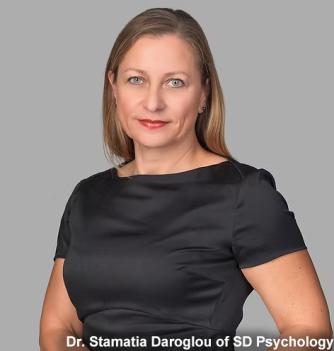
Dr. Stamatia Daroglou didn't start out in psychology. She spent two years studying computer science before auditing a psychology class and switching directions entirely. That pivot led her from Greece to Germany to Louisiana on a scholarship, and eventually to San Diego, where she earned her PhD in Clinical Psychology from the California School of Professional Psychology in 2003.
What followed was a career of unusual breadth. She completed a post-doctoral fellowship in forensic psychology, conducting criminal and family court evaluations. She worked for the California prison system, providing both treatment and parole board evaluations. She taught forensic psychology and psychological testing at multiple universities. She served as a clinical supervisor for an outpatient clinic. She added a Certificate in Adult Psychoanalytic Psychotherapy from the San Diego Psychoanalytic Society and Institute. And through all of it, she maintained a small private practice in La Jolla.
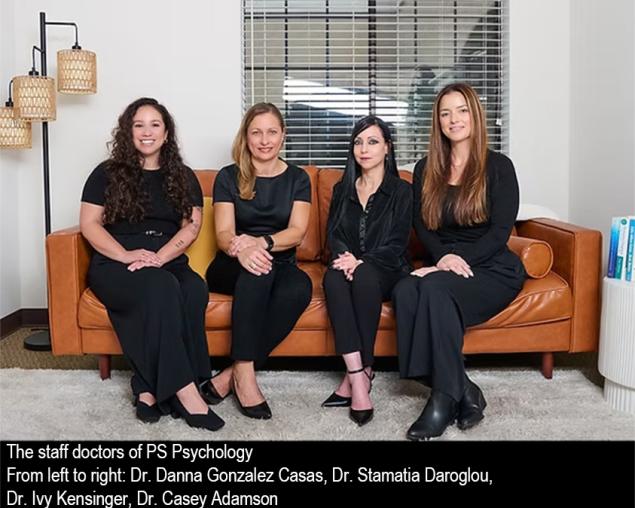
In 2019, she left the Navy and went full-time private. In 2023, responding to a volume of calls she could no longer handle alone, she launched SD Psychology as a formal group practice. Today the practice includes four clinicians, two locations (La Jolla and Encinitas), and a telehealth offering that extends care across California.
The Cancer Patients Nobody Else Was Treating
One of Dr. Daroglou's most distinctive areas of specialization grew from her time at the Naval Medical Center, where she was the only psychologist embedded in an internal medicine clinic. When patients received difficult diagnoses — cancer, diabetes, chronic illness — they didn't have to leave the building to get emotional support. She was down the hall.
"If someone has a new cancer diagnosis, what they're experiencing is a true existential crisis. What does this mean about my life? What does it mean about my family, my kids? What does it mean about my body? And because I work with existential ideas and philosophy, it seems to be helpful. So more people started coming."
That existential orientation — drawn from the psychodynamic and psychoanalytic traditions — distinguishes her clinical approach from more protocol-driven models. She's less focused on symptom checklists and more focused on meaning: how a person understands what's happening to them and what it asks of them.
The same framework applies to her work with healthcare professionals, where the presenting concern has shifted from acute pandemic stress to a more chronic condition: burnout.
"Now it's more about burnout. How do you shift? How do you understand the work that you do? How do you not take all the problems from the hospital home with you to your family?"
Built for San Diego, Not for Scale
When Dr. Daroglou expanded to a group practice, she did it deliberately and locally. Her post-doctoral associates come from the California School of Professional Psychology — her own alma mater — based in Scripps Ranch. The practice serves the San Diego community it's embedded in, and has no plans to scale into something impersonal.
"We answer all the calls ourselves. We do all the intakes ourselves. When someone calls us, they get the psychologist — not an assistant, not a scheduler. It stays really personal."
That intentionality also shapes how Dr. Daroglou thinks about what therapy actually is and when it works. She distinguishes between crisis counseling, which addresses immediate distress, and what she considers the real work of psychotherapy — something that only becomes available once the acute pressure has eased.
"Once the crisis is done, that's when the real work begins. That's when you're relaxed enough to look inwardly — to understand why you think the way you do, how your emotional world is impacting your relationships, and what you can do to shift that."
She also challenges the assumption that therapy is only appropriate in crisis. In her view, it functions more like ongoing maintenance for the mind — most valuable not when everything has gone wrong, but when there's enough stability to do real introspective work.
Still Finding It Rewarding
Three decades in, Dr. Daroglou rates her job satisfaction at a nine or ten. The answer to why comes easily.
"I have never seen anyone go to therapy and not get better. When people start shifting in their thinking — understanding why they do the things they do and how that impacts their relationships — that is amazingly rewarding. You help them understand themselves. You watch them shift. That never gets old."
SD Psychology sees adults navigating anxiety, depression, trauma, grief, chronic illness, life transitions, and relationship challenges. The practice accepts Aetna, TRICARE, TriWest, Medicare, and most PPO plans — insurance, Dr. Daroglou notes, may cover 100% of services.
Contact Information
La Jolla: 7946 Ivanhoe Avenue, Suite 310 | Encinitas: 2210 Encinitas Blvd, Suite W | Virtual therapy also available | (619) 894-1507

